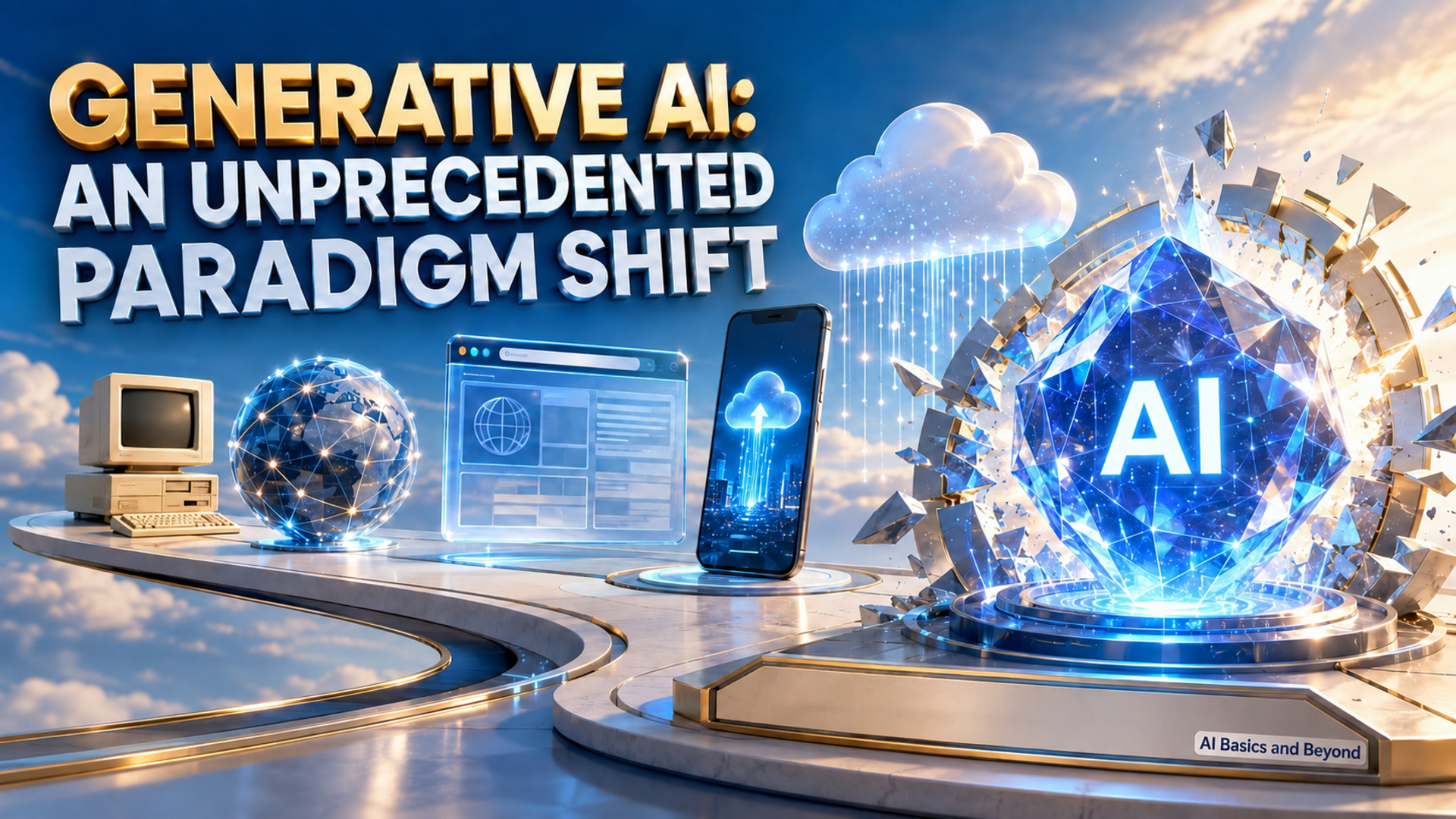
I entered computer technology in 1985. Since then, I have watched supposedly “revolutionary” products arrive with great fanfare and quietly disappear. I have also lived through several genuine paradigm shifts—changes that fundamentally altered our relationship with computers.
Overview
Personal computers moved computing out of corporate data centres and onto individual desks. Graphical interfaces replaced cryptic commands with windows, icons and a mouse. Networks connected isolated computers, while email and the Internet connected people across the world. The Web opened vast stores of information to ordinary users, smartphones put that access in our pockets, and cloud computing made software and data available almost anywhere.
Each development built upon what came before. Generative AI does that too, but it crosses a new boundary.
Earlier computers stored, calculated, displayed and transmitted information according to instructions we supplied. Generative AI can work with information in ways that resemble human creative and analytical activity. We can describe a goal in ordinary language and have it compare evidence, explain a medical report, draft an article, create an illustration, write software or challenge our assumptions.
The computer is changing from a machine we operate into something closer to a collaborator we direct. That makes generative AI potentially the most consequential computing shift I have experienced.
Why the Scepticism and Fear?
Every previous shift attracted sceptics. Personal computers were dismissed as expensive toys. Many people considered the Internet a fad, distrusted online shopping and refused cloud services because their information would be stored “somewhere else.”
Some concerns proved sensible. The Internet created extraordinary access to information, along with scams, surveillance and industrial-strength nonsense. Generative AI also deserves scrutiny. It can invent facts, reproduce bias, mishandle private information and sound remarkably convincing while being completely wrong. Healthy scepticism is not resistance to progress; it is basic quality control.
The fear goes deeper because AI can perform tasks associated with education, experience and human creativity. A calculator threatened arithmetic work. Generative AI can draft the accountant’s report, explain it to the client and design the presentation. People are understandably asking where this leaves them.
AI Does Not Make Employment Decisions
AI will not walk into an office and fire anyone. It does not set staffing levels, approve budgets or decide that shareholder returns matter more than employees. Those decisions are made by the people and organizations using and controlling it.
Some jobs will disappear, and pretending otherwise helps nobody. Many more will be reorganized as particular tasks are automated. A 2025 International Labour Organization study found that one in four jobs worldwide has some exposure to generative AI, but concluded that transformation is more likely than complete replacement.
The sharper risk is that an employer may use AI to reduce staff, a competitor may deliver better work at lower cost, or a colleague using AI effectively may accomplish in an hour what previously required a day. The technology supplies the capability; people decide how the gains and damage are distributed.
After four decades of technological change, I do not fear AI, nor do I expect it to vanish. Understand what it does well, check the accuracy of what it produces, and recognize who gains from its use. In this transition, the safest stance is to be informed enough to help guide the technology—and to question those who control it.