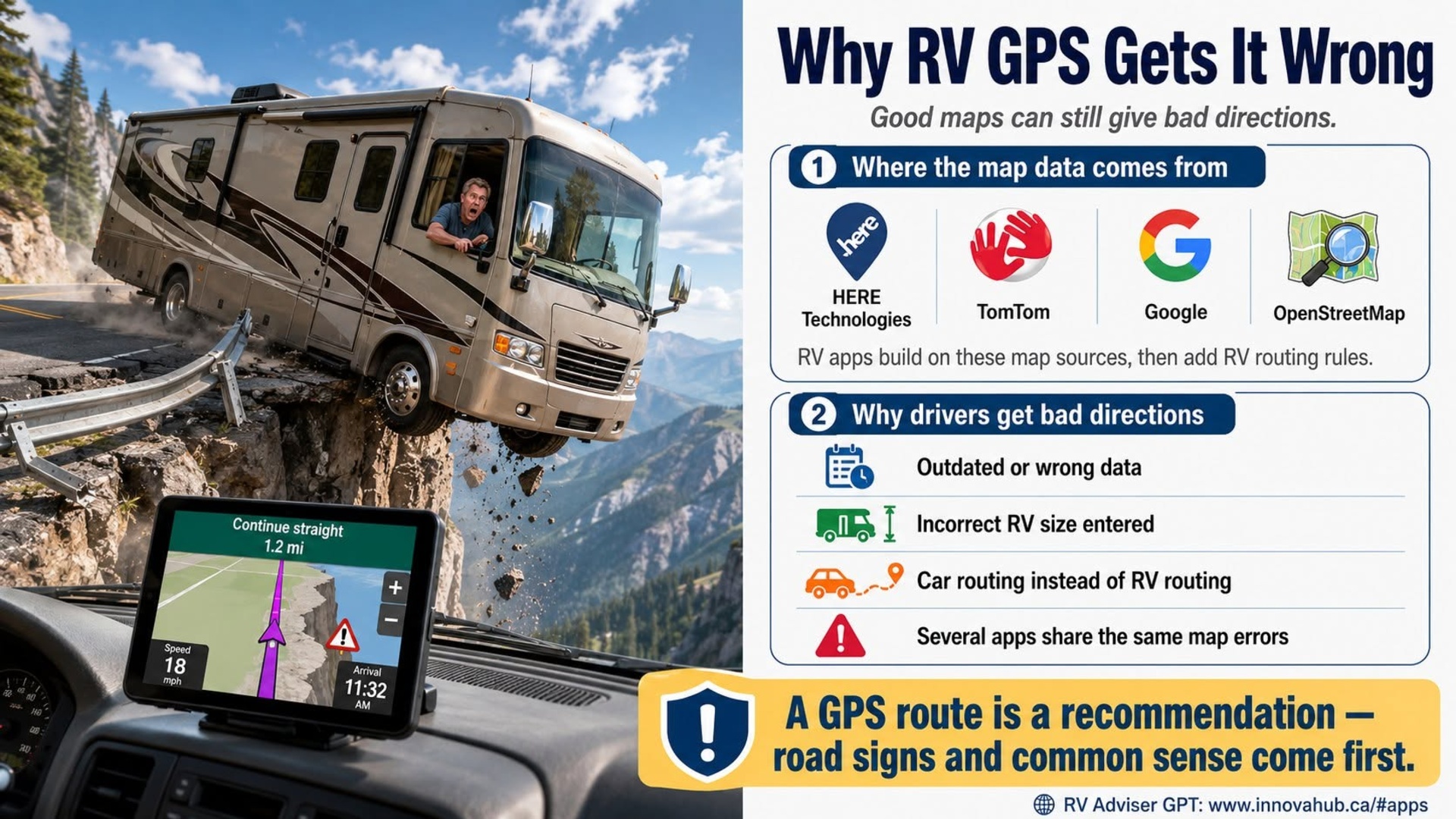
Almost every experienced driver has received GPS directions that made no sense—a closed road, the wrong campground entrance, an unnecessary detour or a narrow back road that no large RV should ever attempt.
Overview
This can and does happen with all GPS systems, regardless of whether they are dedicated devices, such as a Garmin, or apps on mobile devices.
The problem is not always the GPS device or app itself. Navigation systems depend on enormous databases gathered from governments, commercial map suppliers, satellite images, businesses, connected vehicles and user reports. When that information is incomplete, outdated or incorrectly interpreted, the directions can be wrong.
RV navigation adds another challenge. The system must know not only where a road goes, but whether it is suitable for your RV’s height, weight, length and configuration.
Where Do RV Navigation Systems Get Their Maps?
Most RV GPS devices and navigation apps do not create their own maps from scratch. They usually rely on one or more major mapping sources:
HERE Technologies: Used by many Garmin and automotive navigation systems.
TomTom: Provides commercial map data to many navigation, trucking and fleet systems.
Google: Supplies the mapping system behind Google Maps and Waze.
OpenStreetMap: A worldwide, community-built map database used by many smaller apps and services.
RV and trucking apps then add their own information, such as vehicle height, weight, length, propane restrictions, truck routes, campgrounds and road suitability.
Why Do Drivers Still Get Bad Directions?
Bad directions usually happen because the data is missing, outdated or simply wrong. A bridge clearance may be entered incorrectly, a road closure may not yet be updated, or a road may be incorrectly marked as suitable for a large RV.
Other common causes include incorrect RV dimensions, using a passenger-car app instead of RV-specific routing, incomplete restriction data, or the system choosing the fastest route rather than the safest or most practical one.
Several apps can also make the same mistake because they may rely on the same underlying map supplier.
A GPS route is a recommendation, not a command. Road signs, bridge clearances and common sense always come first.