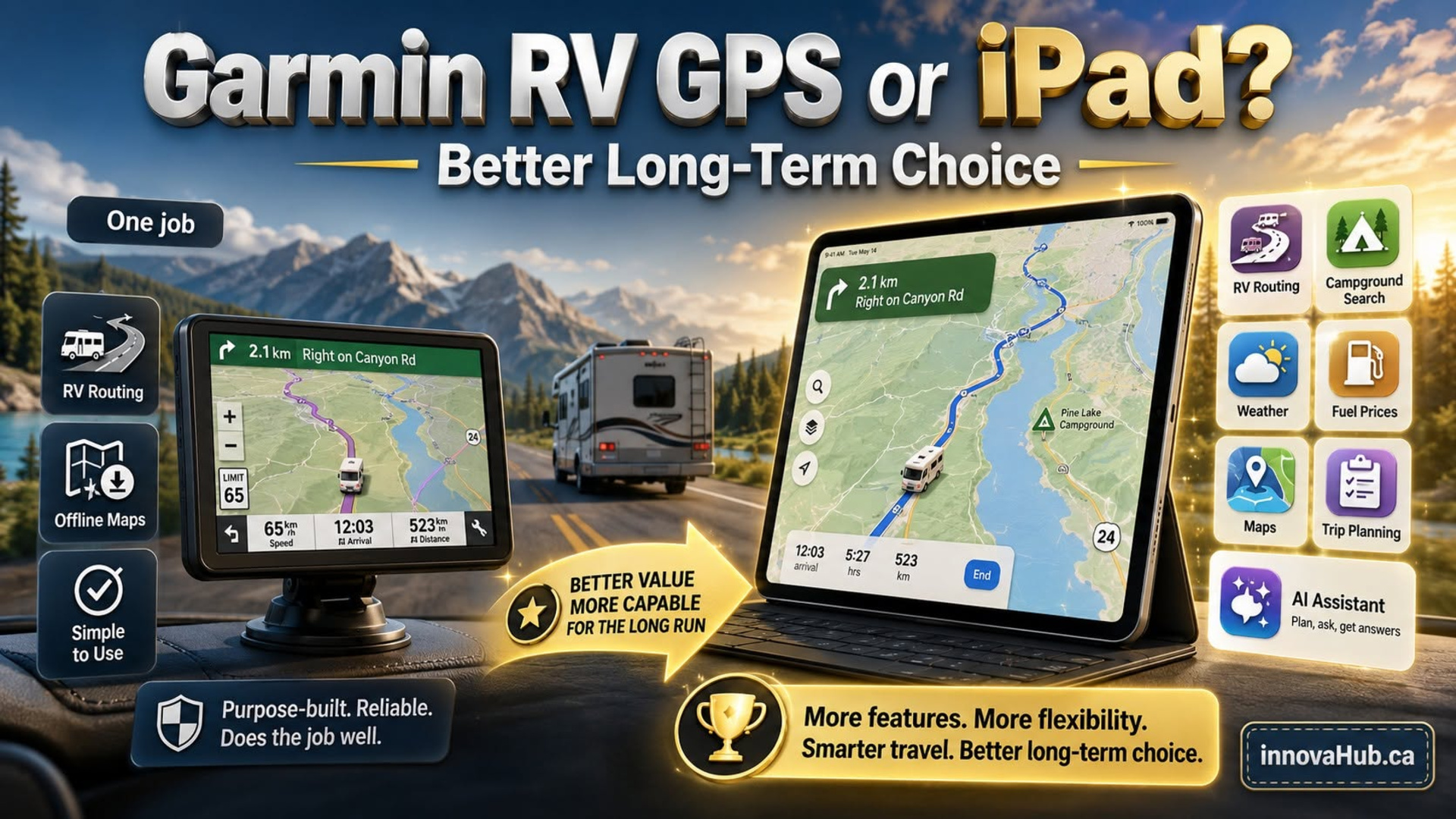
Someone recently asked whether an RVer should buy a Garmin RV GPS or just use an iPad. The replies included the usual claims that Garmin can do things an iPad cannot, such as RV-safe routing, low-clearance warnings, offline maps and campground directories.
Why the iPad Is the Better Long-Term Choice
That argument does not hold up very well anymore.
A top-end Garmin RV unit like the RV 1095 is a capable dedicated navigator. But the idea that it offers unique RV features an iPad cannot match is outdated. With the right apps, a cellular-capable iPad can do essentially all of the important navigation jobs a Garmin can do, and then a great deal more. Once you compare cost, flexibility and likely future usefulness, the iPad comes out ahead for most RV owners.
What the Garmin RV 1095 Does Well
The Garmin RV 1095 is built around a simple promise: enter your RV’s size and weight, and it will try to route you more appropriately. It also provides low-clearance and road warnings, voice navigation, lane guidance, campground and service directories, trip planning and offline North American maps. When paired with a phone, it can also pull in traffic, weather and fuel-price information.
That is all useful. Garmin deserves credit for packaging it neatly in one device.
Its main advantage is not superior capability. Its main advantage is convenience. It is a ready-made appliance. Mount it, power it and go. For RVers who want one dedicated screen and do not want to think about apps, subscriptions or setup, that has value.
The problem is the price. The RV 1095 sells for around US$900 and roughly C$1,250 to C$1,320 in Canada. That is a lot of money for a device that does one thing.
Why the iPad Makes More Sense
A current 11-inch iPad with cellular capability starts at around US$599 or C$849. Add an RV navigation app such as RV LIFE Pro at about US$65 per year, and you now have RV-aware routing, turn-by-turn navigation, offline maps, trip planning, campground reviews and low-clearance guidance.
That already puts the iPad in the same conversation as Garmin. But the iPad does not stop there.
It can also run Google Maps, Apple Maps, Waze, weather radar, fuel-price apps, road-condition apps, satellite imagery, reservation tools and campground research apps. It can store manuals, run email, stream entertainment, handle video calls, browse reviews, manage checklists and serve as your general travel computer. In practical terms, it replaces not just a Garmin, but often several other devices and a pile of paper.
Even after adding a decent mount and charger, the iPad remains very competitive on cost. And unlike the Garmin, it still has value when you are not driving.
The Real Difference: Closed Tool vs. Flexible Platform
This is where the iPad case becomes much stronger.
A Garmin gives you the features Garmin decided to include. An iPad gives you a platform that can keep improving. If one app is weak, you switch apps. If a better campground app appears next month, you install it. If you want satellite imagery, offline public land maps, weather overlays or a better trip planner, you are not stuck waiting for one manufacturer to catch up.
That flexibility matters because RV travel is not just about following a magenta line down the highway. Real travel decisions involve weather, closures, fuel stops, campground quality, alternate routes, local conditions and the ability to look something up quickly when plans change. A tablet handles that broader job far better than a dedicated GPS.
Claims that “Garmin does things an iPad cannot” usually come from people who either have not explored what current apps can do or simply prefer the comfort of an older, simpler approach. That preference is understandable. But it should not be mistaken for a capability gap.
Where Garmin Still Wins
To be fair, Garmin still has a few genuine advantages. It is simpler. It is built for one purpose. It is less likely to distract the user with other apps, and it may handle constant vehicle use and heat somewhat better than a consumer tablet.
An iPad also needs a proper mount, a charging setup and some common sense about sunlight and heat. Leave it cooking against the windshield in July and you may have a problem.
Those are real drawbacks. They just are not strong enough to overcome the iPad’s larger advantages for most people.
The Future Favours the iPad Even More
This is the part many buyers overlook. Navigation is changing quickly, and AI is accelerating that change. Route planning, hazard awareness, trip research, conversational search, campground comparison and real-time travel assistance are all moving toward smarter, software-driven systems.
A general-purpose device like an iPad is much better positioned for that future. New apps and software updates can add entirely new abilities. A dedicated GPS is limited by the pace and priorities of its manufacturer.
That does not make Garmin obsolete overnight. But it does make it harder to justify spending top dollar on a single-purpose device when a less expensive iPad can do the same core job, do many other jobs too and is better placed for what comes next.
If you want the simplest possible appliance, buy the Garmin. If you want the better tool, better value and better long-term bet, buy the iPad.