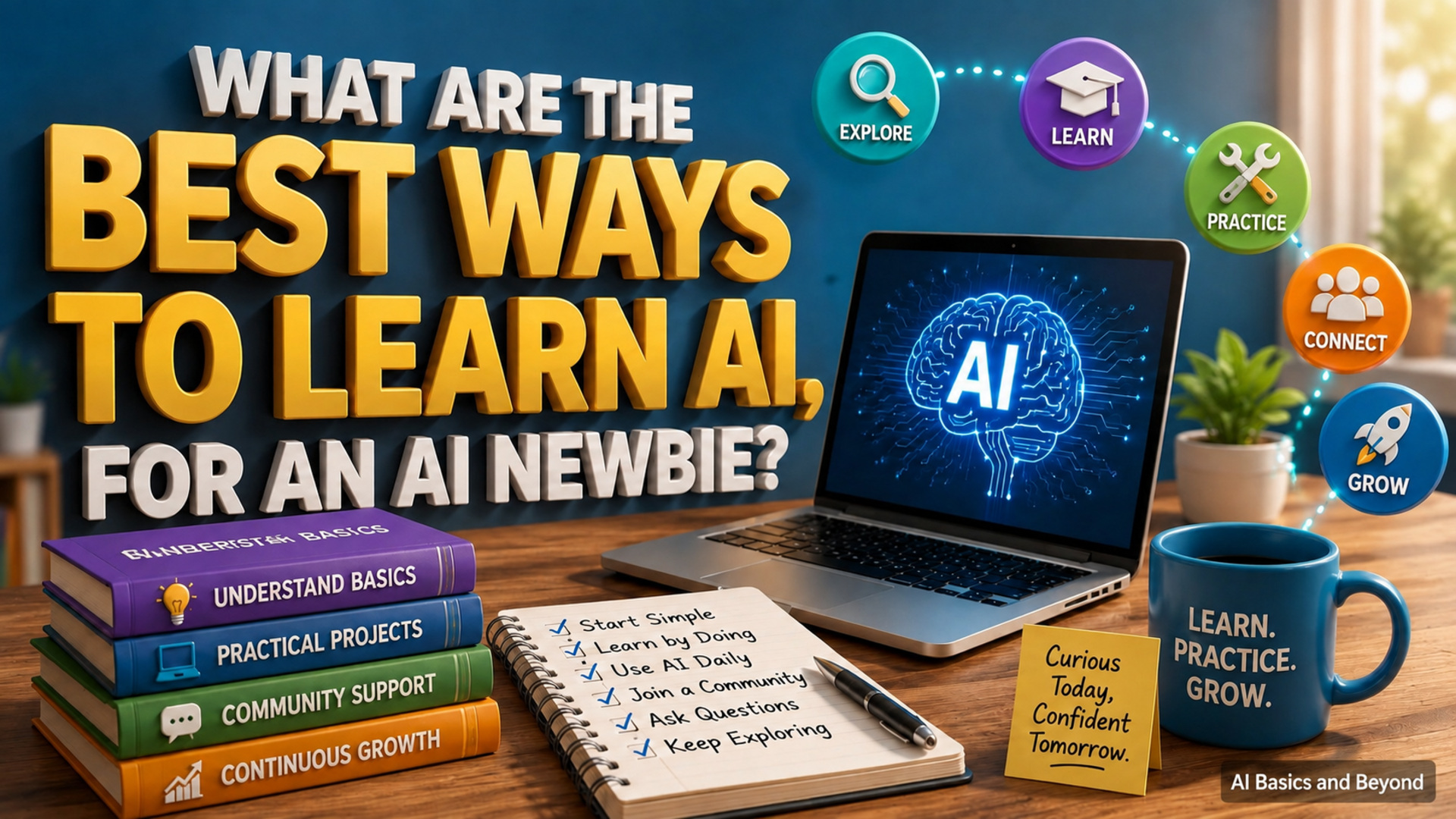
For most beginners, the hardest part of learning artificial intelligence is deciding where to begin. The good news is that you do not need to understand computer programming, neural networks, or complicated terminology before using generative AI effectively.
Begin With Real Tasks, Not Technical Theory
Start with a familiar task you already do: rewrite an email, summarize a long article, plan meals, compare products, organize travel ideas, or explain something you find confusing. Working with real tasks gives you an immediate reason to learn and makes the results easier to judge.
Think of an AI assistant as a capable but imperfect helper. It can save time, explain ideas, and generate useful starting points, but it can also misunderstand instructions or confidently provide incorrect information. Learning to use AI includes learning when not to trust it.
Learn Through Conversation
You do not need to write elaborate prompts. Begin by clearly explaining what you want, who the answer is for, and how you want it presented.
For example, instead of asking, “Tell me about home insurance,” try:
“Explain the main types of home insurance in plain English for a first-time homeowner in Canada. Include the questions I should ask an insurance broker.”
Then continue the conversation. Ask the AI to simplify the answer, add an example, question its assumptions, or explain where its information might be uncertain.
Official guidance from OpenAI and Google emphasizes clear instructions, useful context, and repeated refinement rather than searching for one magical prompt. Prompting is an iterative process: ask, review, correct, and try again.
Build Skill Gradually
Choose one or two AI tools and use them regularly before chasing every new app that appears. Constantly switching platforms can make you feel busy without making you more capable.
A simple learning routine works well:
- Use AI for one practical task each day.
- Save prompts that produced especially useful results.
- Compare the answer with a trusted source when accuracy matters.
- Ask the AI to explain how the prompt could be improved.
- Experiment with text, images, documents, and voice as your confidence grows.
Free beginner courses can provide structure. Microsoft, for example, offers introductory learning modules covering generative AI, large language models, and prompts. OpenAI also provides beginner prompting resources.
Learn With Other Everyday Users
Joining a group focused on practical beginner and intermediate AI use can shorten the learning curve considerably. Communities such as AI Basics and Beyond give members a place to ask ordinary questions, see how others use AI, and learn from both successes and mistakes.
The most helpful groups are not built around hype or technical one-upmanship. They encourage questions, explain things clearly, and remind members to verify important information.
The Practical Takeaway
You learn AI the same way you learned email, smartphones, or online banking: one useful task at a time.
Start small, stay curious, and question the results. The goal is not to become an AI expert overnight. It is to become confident enough to recognize where AI genuinely helps—and sensible enough to know when it does not.