Few campground activities attract an audience faster than someone backing an RV into a tight site. Before long, a few neighbours are sitting in lawn chairs with an adult beverage, quietly rating the performance. The goal is to be the useful demonstration—not the evening’s comic interlude.
Overview
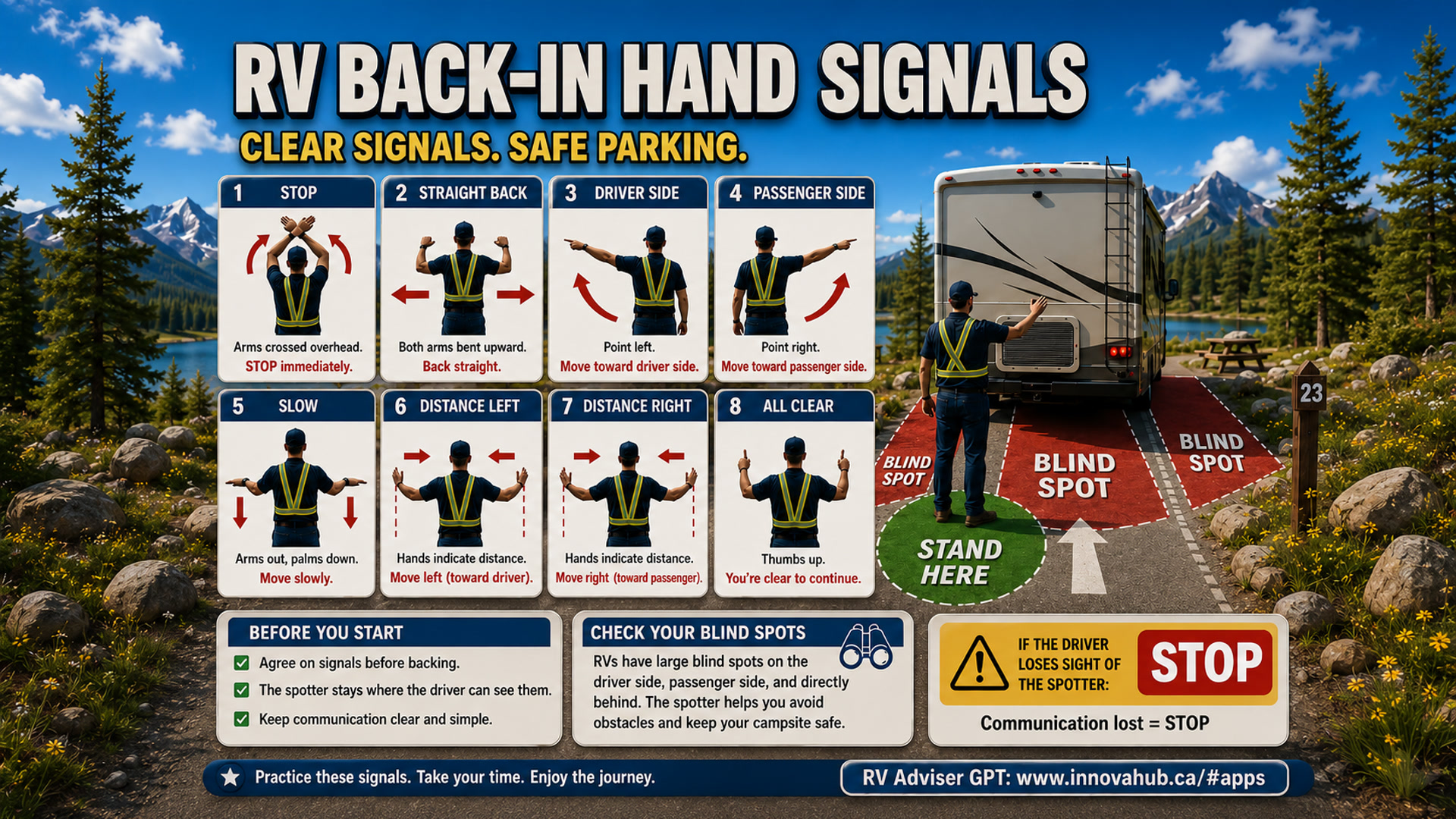
Backing a trailer or motorhome works best with two people: one person drives and one person directs. Before moving, both should agree on the signals and one non-negotiable rule: if the driver cannot see the spotter, the driver stops immediately.
The Hand Signals
Stop: Cross both arms clearly above your head. This means stop immediately—not after another foot.
Straight Back: Bend both arms upward and repeatedly draw your hands toward your shoulders or chest.
Move Toward the Driver’s Side: Extend one arm and point firmly toward the driver’s side. Use the same terms every time rather than “left” or “right,” which can become confusing when people face opposite directions.
Move Toward the Passenger’s Side: Extend one arm and point toward the passenger’s side.
Slow: Hold both arms out with palms facing downward and move them slowly toward the ground.
Distance Remaining: Hold your hands apart to show the remaining space, then gradually bring them together. When your hands meet, the vehicle should stop.
All Clear: Give a clear thumbs-up only when the RV is stopped and correctly positioned. It should never mean “keep backing without watching me.”
Where the Spotter Should Stand
The spotter should normally stand near the rear corner on the driver’s side, outside the RV’s path and where the driver can clearly see them in the mirror. Never stand directly behind the RV, between the RV and an obstacle, or where the trailer could swing toward you.
The spotter’s job is to show where the trailer or motorhome needs to go. Leave the steering, throttle and brake decisions to the driver. Saying “move the rear toward the driver’s side” is far clearer than trying to tell the driver which way to turn the wheel.
The spotter should walk forward or sideways when repositioning—not backward while staring at the driver. Phones, pets, campsite conversations and enthusiastic bystanders can wait.
Check the Blind Spots
Before backing, both people should walk the entire campsite and look for posts, branches, picnic tables, hookups, rocks, children and low-overhead hazards. Cameras and mirrors help, but neither shows everything. Stop and get out for another look whenever the spotter changes position or anything becomes uncertain.
Visibility becomes considerably worse after dark and during rain. Wet mirrors reflect glare, backup cameras lose detail, and dark clothing can make the spotter nearly disappear. Use bright clothing, a reflective vest and a flashlight after dark, but never shine the light into the driver’s mirrors. In poor conditions, move more slowly and stop more often.
Backing is not a speed contest. A second attempt is routine; repairing picnic bench damage is not.