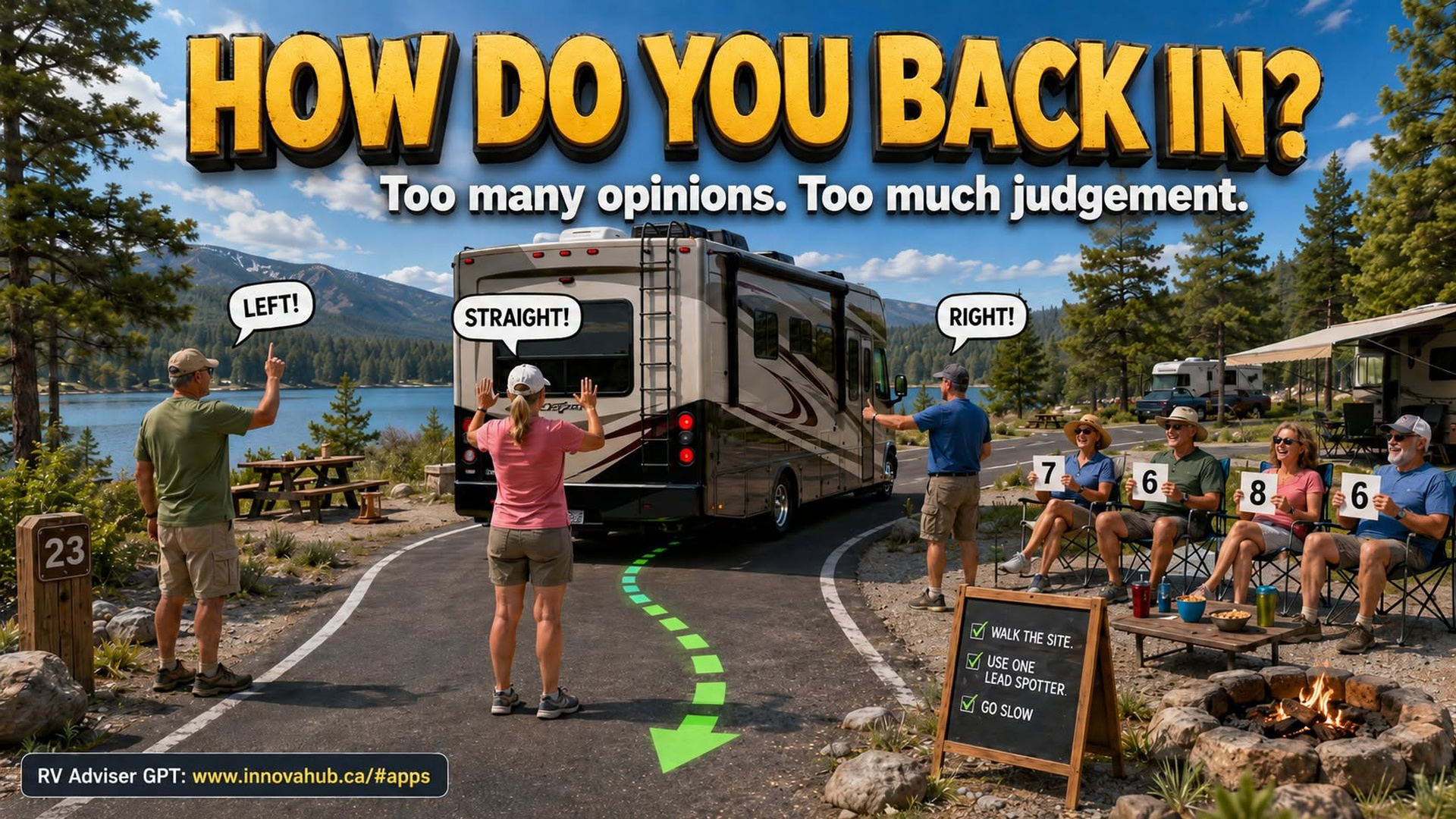
Backing an RV into a campsite can turn a quiet campground into live theatre. Before long, a few neighbours are sitting in lawn chairs with adult beverages, watching every correction and quietly judging your competence.
Overview
Let them watch. Your job is not to entertain the campground. It is to place the RV safely, without damaging the rig, the site or each other’s patience.
Walk the Site Before You Move
Stop and inspect the campsite before backing in. Check the road width, trees, posts, rocks, picnic tables, fire rings, low branches and uneven ground. Look up as carefully as you look behind. Roof air conditioners and vents are expensive ways to discover a branch.
Decide where the RV needs to finish, not just how to get it through the entrance. Consider slide-out clearance, awning space, hookups, levelling, door access and room for the tow vehicle. A neat backing job is not much use if the sewer connection is twenty feet away or the slide opens into a tree.
Whenever practical, approach so the campsite is visible on the driver’s side. Backing toward the passenger side creates a larger blind area and makes it harder to judge the RV’s angle.
The Spotter Directs the RV
A spotter’s job is to direct where the rear of the trailer or motorhome needs to go. The driver remains responsible for steering, braking and controlling the vehicle.
Before moving, agree on a few simple signals: stop, straight back, move left, move right and distance remaining. Directions should refer to the rear of the RV, not the steering wheel. “Move the rear two feet toward me” is clear. “Turn the wheel the other way” is how arguments begin.
The spotter should remain where the driver can clearly see them in a mirror while staying out of the vehicle’s path. The spotter must also watch the front swing of the tow vehicle or motorhome, not just the rear bumper. If the driver loses sight of the spotter, the driver stops immediately.
Phones or two-way radios can help, especially at night or in heavy rain, but they do not replace visibility. Keep instructions short and specific. Long explanations and frantic arm waving create more confusion than useful information.
When Volunteer Helpers Appear
Campgrounds tend to produce volunteer helpers at exactly the moment you need fewer voices.
Some are useful. Accept help when you are backing alone, visibility is poor or one area cannot be seen by your primary spotter. Give the volunteer one clear job, such as watching the passenger-side rear corner or checking overhead clearance.
Do not allow several people to direct the driver. The driver should follow one spotter only. Everyone else should report hazards to that person rather than issuing separate signals.
It is perfectly reasonable to decline help. A simple “Thanks, we have a system” is usually enough. If someone keeps waving anyway, stop and make it clear who is directing the move. Conflicting instructions are not harmless background noise. They are a safety problem.
A helper who disappears from view, stands in the travel path or gives vague, contradictory directions is no longer helping. Stop and reset.
Backing a Trailer
With a travel trailer or fifth wheel, begin with small steering inputs. The trailer reacts after a delay, and overcorrecting can quickly create an angle that is difficult to recover.
Many drivers find it helpful to place one hand at the bottom of the steering wheel. Move that hand in the direction you want the rear of the trailer to travel. Once the trailer begins turning, steer back toward centre and follow it into the site.
Pull forward and reset whenever the angle becomes poor. Experienced drivers do this regularly. Trying to rescue a bad approach often takes longer and increases the risk of jackknifing or striking an obstacle.
Motorhomes respond more directly, but long rear overhangs can swing sideways as the front turns. The spotter needs to watch both ends.
Backup cameras, sensors and trailer-assist systems are useful, but they do not show every branch, post, child, pet or low obstacle. Use them as another source of information, not as a replacement for mirrors, a spotter and getting out to look.
Back slowly, stop often and check whenever you are uncertain. The campground audience may lose interest, but your RV will still have all its corners.