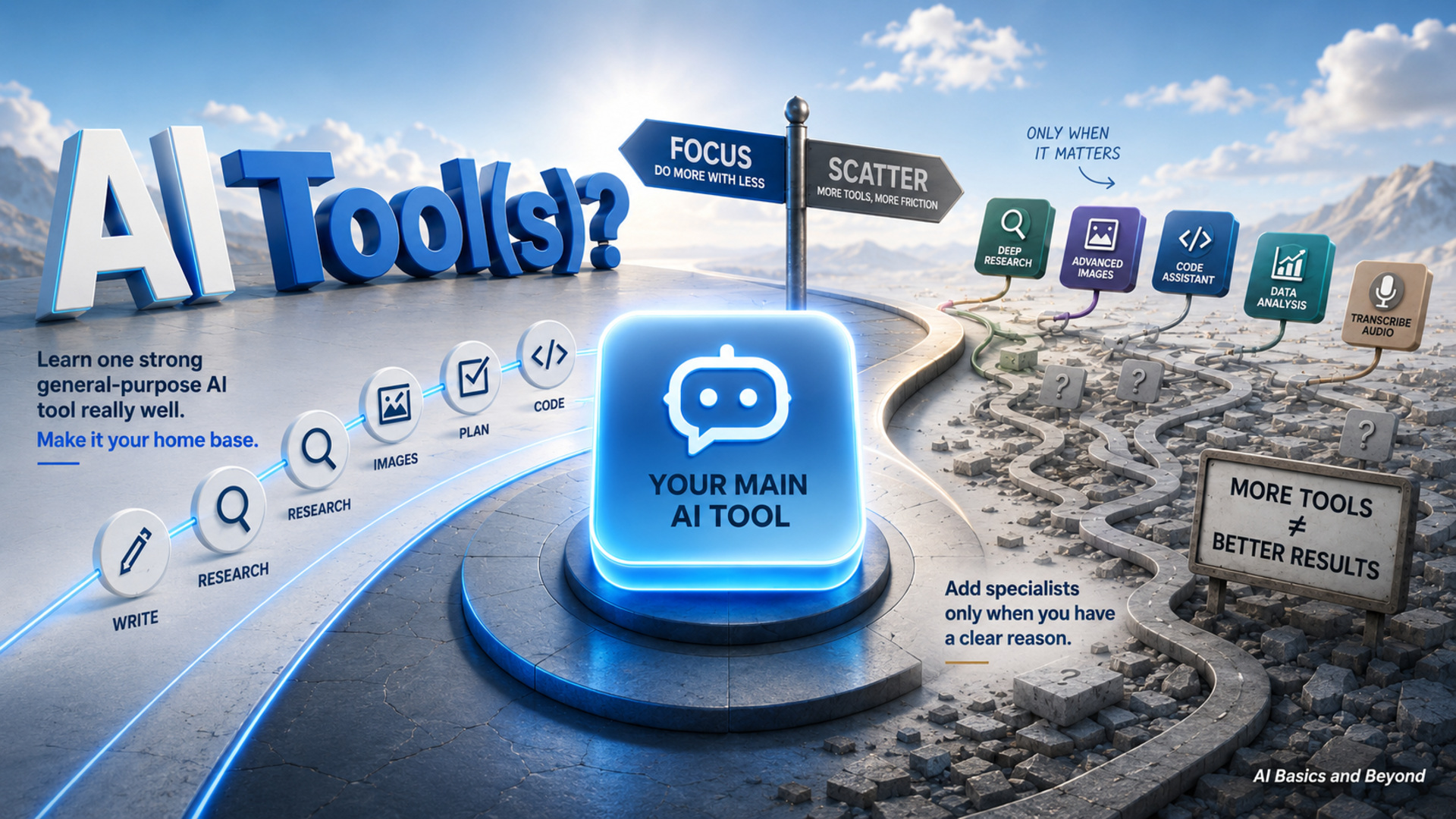
Spend any time reading about AI and you will soon be told that one tool is not enough.
Overview
Use ChatGPT for this. Claude for that. Gemini for something else. Then add a separate image generator, a research tool, a coding assistant, and perhaps a few specialized apps you had never heard of until someone posted their “essential AI stack.”
Some of that advice is valid. Different AI tools do have different strengths.
But for the average person trying to use AI for everyday tasks, I think the multi-tool message is often overdone.
One Good Tool Can Take You a Long Way
Most people are using AI for a fairly broad mix of tasks. They write emails, summarize information, plan trips, research purchases, improve documents, brainstorm ideas, create images, or ask questions.
A capable general-purpose AI tool can handle most of that reasonably well.
The bigger productivity gain often comes from learning how to use the tool properly.
You learn how much context to give it. You learn how to correct a poor answer instead of immediately starting over. You understand its strengths, its weak spots, and which features actually help you.
You also build a more consistent workflow.
Your projects, files, conversations, and instructions are easier to find when most of your work lives in one place. The more platforms you use, the more often you find yourself repeating instructions, uploading the same files, and trying to remember where a particular conversation took place.
At some point, you are no longer saving time with AI.
You are managing AI.
When More Than One Tool Makes Sense
There are good reasons to use multiple AI tools.
A writer may prefer one platform for long-form editing. A programmer may use a specialized coding assistant because it saves hours each week. Someone heavily invested in Google products may find Gemini fits naturally into their workflow. Video creators often need separate tools for voice, animation, images, and video generation.
The important question is whether the extra tool solves a real problem.
I would add another AI platform when I can clearly say:
“This tool regularly does something my main AI does poorly, or it saves me enough time to justify learning and paying for it.”
That is a practical reason.
Using several AI tools because someone posted a colourful chart showing their “ultimate AI workflow” is not.
Be Careful With the Hype
AI content has become an industry of its own.
New tools generate videos, articles, affiliate links, comparisons, and sponsorship opportunities. There is always a new model that is supposedly destroying, replacing, or embarrassing the tool everyone was using last month.
That does not mean every recommendation is dishonest.
It does mean the person recommending another subscription may have a different goal than you do.
Their goal may be creating content. Your goal is getting work done, and those are not always the same thing.
AI platforms are also changing quickly. Features that once required a separate app are increasingly appearing inside larger general-purpose tools. A specialized tool that seems essential today may become redundant six months from now.
Before paying for another subscription, I would take a hard look at whether I actually need it.
Pick a Home Base
For most people, I recommend choosing one strong, general-purpose AI platform and making it your home base.
Learn it well.
Use it for most of your everyday work. Get comfortable refining prompts, checking answers, working with files, and continuing projects over time.
Then add specialized tools when a clear need appears.
There is also nothing wrong with occasionally taking an important question to a second AI and comparing the answers. That can expose weak reasoning or give you another point of view.
Just remember that asking two AIs the same question is not the same as fact-checking. They can both be wrong.
Professionals may genuinely need a toolbox full of specialized AI products.
Most people probably do not.
For the average user, one capable AI tool, used well, is usually more productive than five tools used occasionally.
Before adding another platform, ask one simple question:
“What problem will this solve that my current AI does not solve well?”
If you cannot answer that clearly, you probably do not need another AI tool.