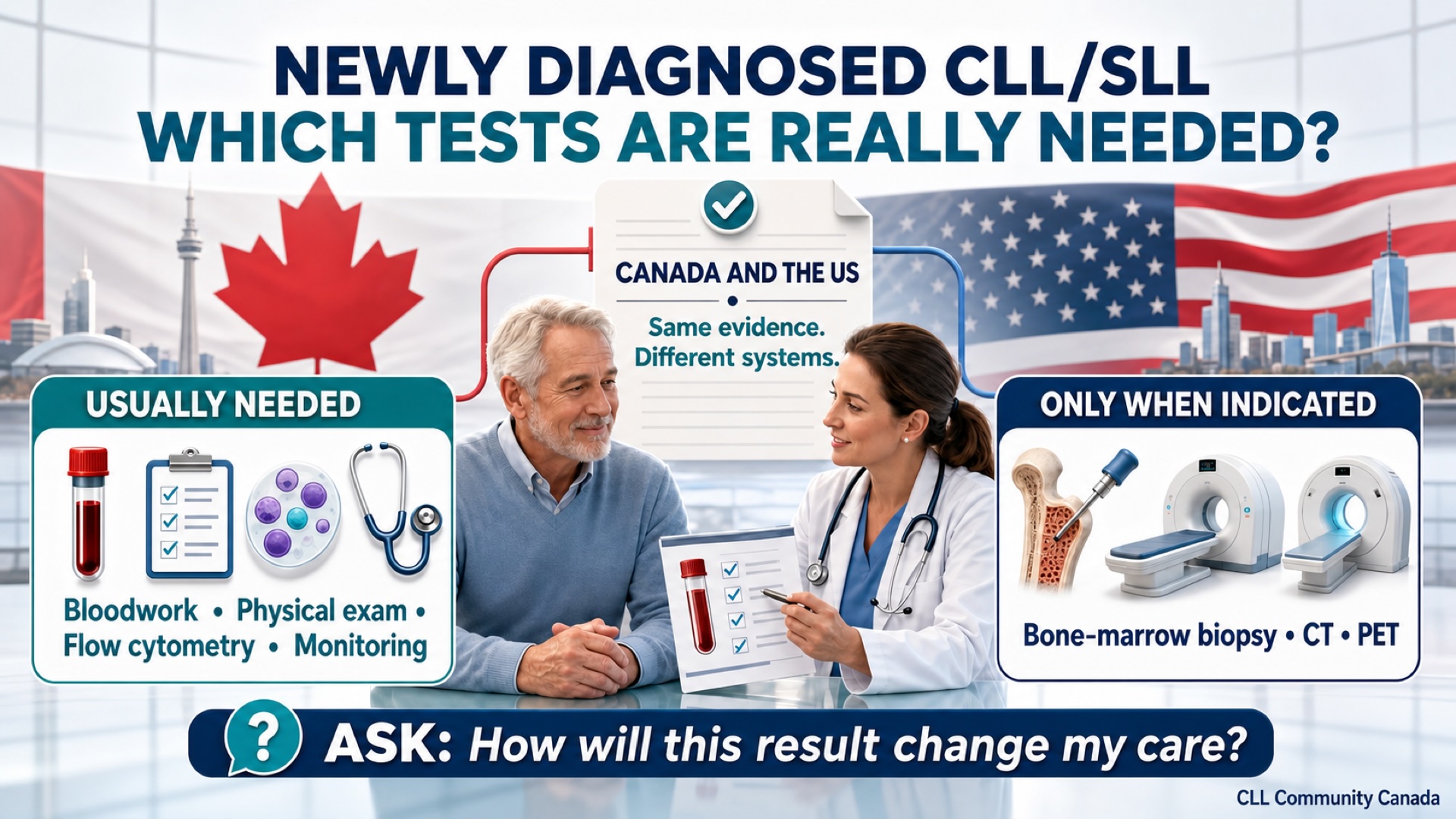
Imagine someone whose CLL or SLL was diagnosed only recently, perhaps after routine bloodwork or an examination. They feel well and have no unexplained fevers, drenching night sweats, weight loss, troublesome fatigue, rapidly enlarging lymph nodes, low blood counts or other suspected complications.
Overview
For this patient, the appropriate initial evaluation is usually far less extensive than some social-media discussions suggest.
What Is Normally Needed?
CLL is generally diagnosed through a complete blood count, blood smear and flow cytometry confirming a characteristic population of clonal B cells. When the abnormal cells are found mainly in lymph nodes rather than the blood, the condition is called SLL. It is essentially the same disease, presenting in a different location.
SLL commonly requires a lymph-node or other tissue biopsy for confirmation. Straightforward CLL usually does not require a lymph-node or bone-marrow biopsy.
The initial assessment will normally include a medical history, physical examination and bloodwork. The doctor should check the lymph nodes, liver and spleen and ask about infections, fatigue, weight changes, night sweats and other possible symptoms.
Common blood tests include:
- A complete blood count with differential
- Kidney and liver-function tests
- LDH and sometimes beta-2 microglobulin
- Immunoglobulin levels in selected patients
- Additional tests when anemia, low platelets or another abnormality needs investigation
For many newly diagnosed people, this provides enough information to establish the clinical stage and begin active surveillance—often called watch and wait.
Tests That May Not Be Necessary
A bone-marrow biopsy is no longer routinely required to diagnose uncomplicated CLL. It can be useful when the cause of anemia, low platelets or other abnormal blood counts is unclear, or when specific information is needed before treatment. Performing one simply because “that is what we always do” is not a convincing medical reason.
Routine CT scans are also generally unnecessary for an asymptomatic, early-stage patient. Physical examination and bloodwork are normally sufficient for staging. A CT becomes more reasonable when the doctor suspects internal lymph-node enlargement, organ involvement or another problem that could affect management.
A PET scan has even less routine value. CLL cells usually do not produce the intense PET activity seen with more aggressive cancers. PET is mainly used when Richter transformation or another complication is suspected—usually because of rapidly growing nodes, unexplained fever, pain, weight loss or a sharp rise in LDH.
The practical question is not whether a test can find something. Modern imaging almost always finds something. The question is whether the result is likely to change care.
Prognostic Testing
FISH testing, TP53 mutation analysis and IGHV mutation status can help predict disease behaviour and guide treatment choices. Many American CLL specialists order a complete prognostic profile soon after diagnosis. Some Canadian clinics defer part of this testing until treatment appears likely.
Both approaches can be defensible. IGHV status generally remains stable, while FISH and TP53 findings can change and must be reassessed before treatment. Early testing may help patients understand their disease, but it rarely changes the immediate plan when treatment is not indicated.
Why Canadian and American Experiences Differ
The medical evidence is broadly similar in both countries. The systems delivering the care are not.
Canadian specialists work within provincially funded systems with limited imaging capacity and strong pressure to justify costs. That discourages unnecessary testing, but it can also produce longer waits and uneven access between provinces.
American patients may receive faster imaging, broader molecular panels and more frequent testing, depending on their insurance and treatment centre. Some of this represents excellent, thorough care. However, much of the American system still pays providers and facilities for each service performed. That creates a real financial incentive to do more—even if no individual doctor is consciously exploiting anyone.
Canada has the opposite risk: cost control can sometimes delay or restrict something genuinely useful. Neither system deserves blind trust.
Drug access also differs. The FDA and Health Canada approve treatments separately, and Canadian provinces then decide whether and how they will fund them. A treatment widely discussed in an American group may not yet be publicly available—or may be used differently—in Canada.
The bottom line is simple: a recently diagnosed, symptom-free CLL/SLL patient usually needs careful confirmation, appropriate bloodwork, examination and ongoing monitoring—not an automatic collection of scans and invasive procedures. For every proposed test, it is reasonable to ask: “What question are we trying to answer, and how could the result change my care?”