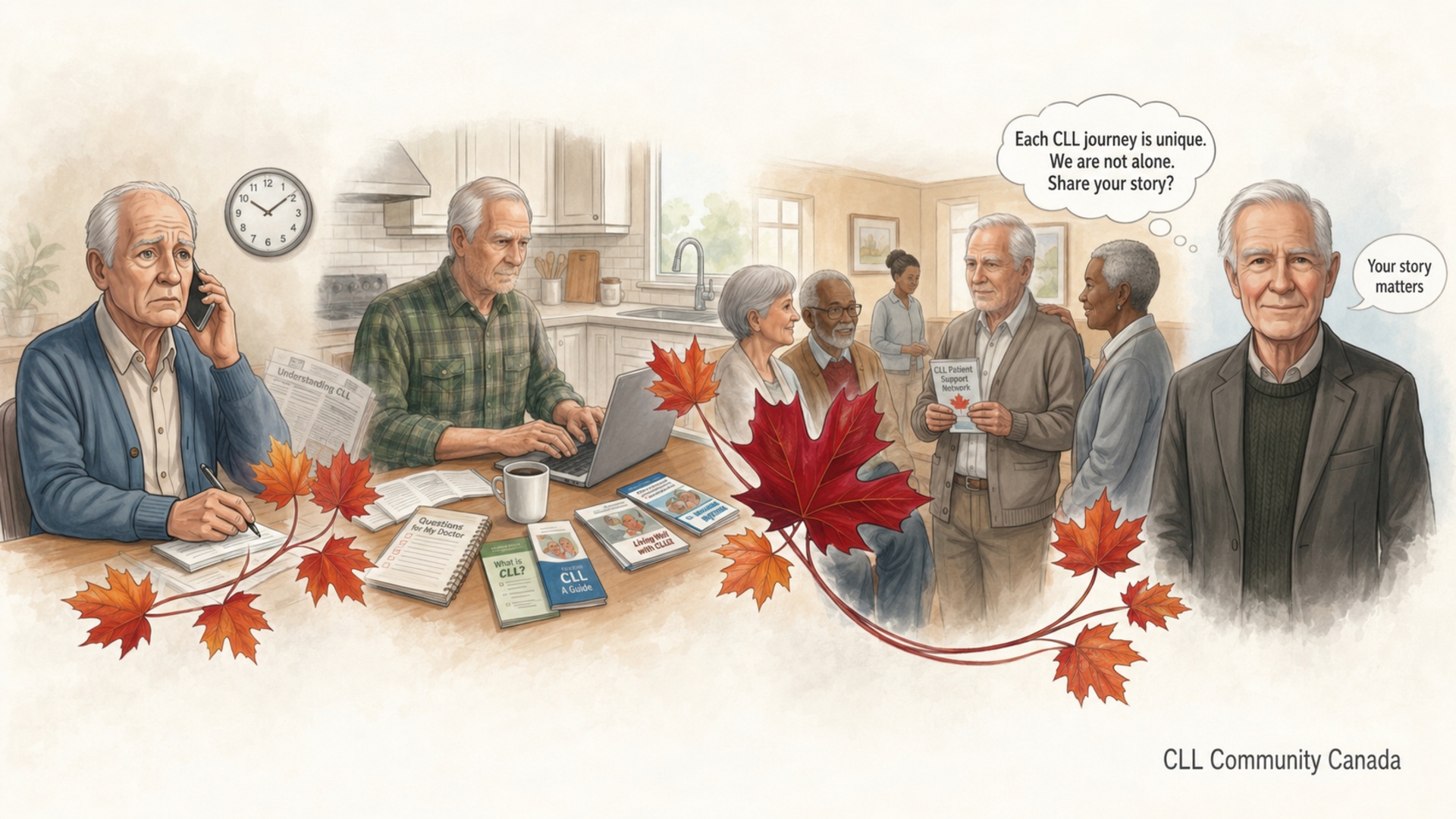
I still remember when I first heard the term CLL. It was December 2020, when I got a phone call from a doctor at BC Cancer. My family doctor had asked her to review my case because my white blood cell counts had been elevated for quite some time. Out of nowhere, I was told I had a cancer that included the word leukemia, and then I was given an appointment for the following September.
Overview
That moment stayed with me. So did the long stretch of waiting that came after it.
Learning to Live With Uncertainty
One of the hardest parts of CLL, at least for me, was not just hearing the diagnosis. It was everything that came with it afterward: the uncertainty, the unfamiliar language, the waiting, and the sense of being pulled into a world I had never expected to be part of.
Like many people, I had a choice in how I responded. I could step back and let the experience overwhelm me, or I could start learning. I chose to learn.
Over time, that meant reading, asking questions, looking for reliable information, and trying to make sense of a condition that can often feel confusing even when it is explained by professionals. The more I learned, the more I realized how many patients and caregivers were trying to do the same thing while also dealing with fear, fatigue, and uncertainty.
Finding Purpose in the Process
As time went on, my learning began to turn outward. I found myself wanting not only to understand CLL better, but also to make the information easier for others to follow. Not everyone has the time, energy, or background to work through medical language, conflicting opinions, and scattered resources, especially while carrying the emotional weight of a diagnosis.
Much of what I learned early on came from U.S. sources, simply because that was where so much of the available CLL information and discussion could be found. But the more I read, the more I realized that the American medical system is very different from the Canadian one, and that not everything translates neatly across the border. That realization was one of the things that drew me toward becoming more involved in the Canadian CLL community.
My goal was never to act as though I had special answers. It was simply to help make the space a little more useful, a little more welcoming, and a little less overwhelming for people trying to find their footing with a CLL diagnosis in the Canadian medical system.
For me, that became one meaningful way of living with CLL: learning what I could, sorting out what was relevant in a Canadian context, sharing what seemed helpful, and reminding others that they were not facing this alone.
There Is No One Right Way
If there is one thing I have taken from this journey, it is that being active does not look the same for everyone. For some people, it means digging into the details, asking a lot of questions, and getting deeply involved. For others, it means taking things one appointment at a time, trusting their care team, and protecting their peace. Both approaches, and many others in between, are valid.
CLL changed my path, but it did not take away my sense of purpose. If anything, it pushed me to be more thoughtful about how I use my time, what I pay attention to, and how I can be of some help to others walking a similar road.
This is my CLL journey. It is not a model for anyone else, just an honest account of how I have tried to deal with it. Your story may be quieter, more private, more active, more passive, or something else entirely, and that is okay. There is no single right way to live with CLL.
If you feel comfortable, I would genuinely like to hear a little about your own journey too.