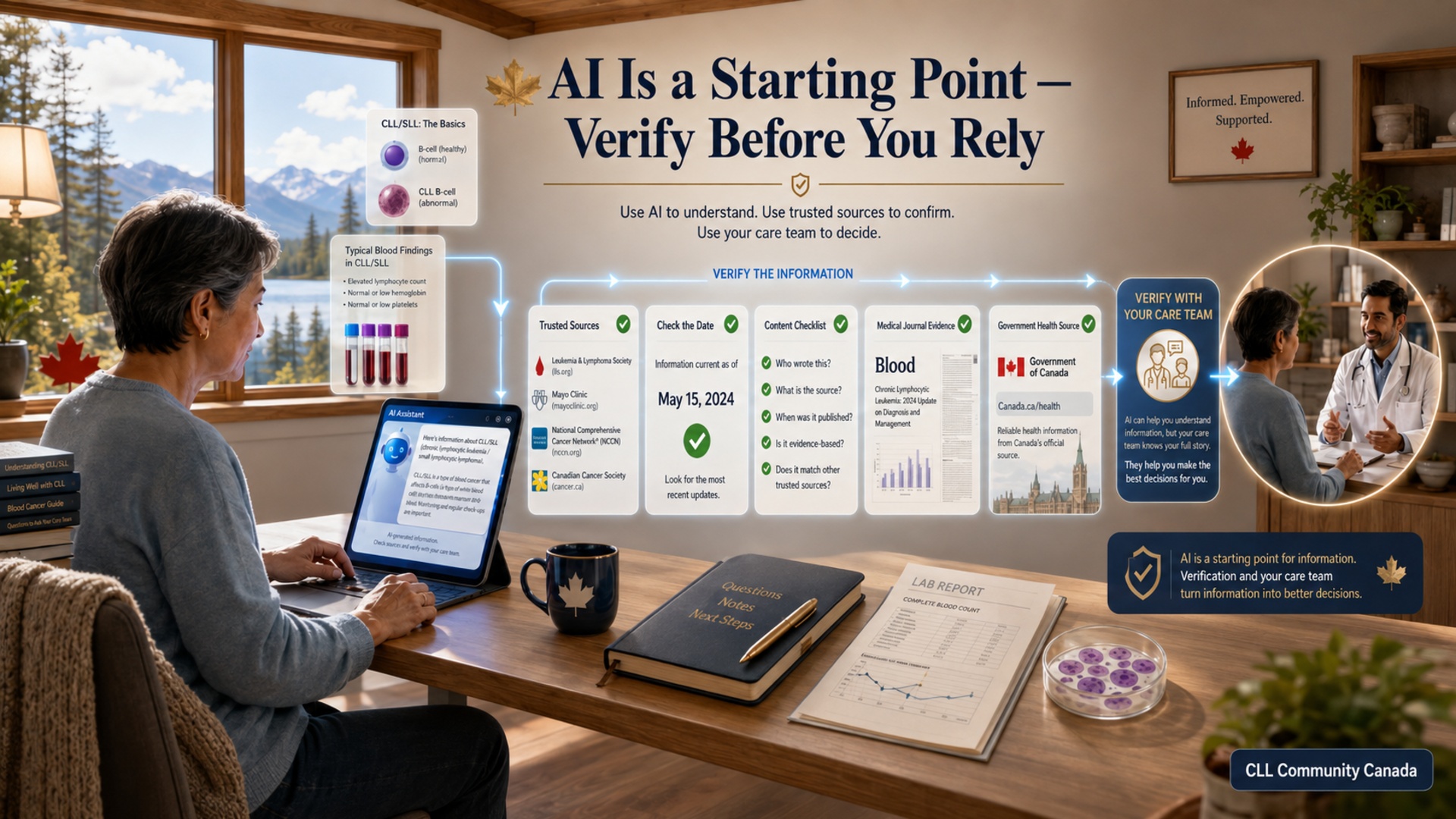
AI can produce polished but incorrect answers. Learn to assess sources, check dates, separate facts from advice, recognize overconfidence, and verify important health information before acting.
AI Is Useful, but It Is Not Always Right
AI assistants, such as ChatGPT, Gemini, or Copilot, are powerful tools, but here is the part many people miss: an AI answer can sound confident, polished, and believable even when it is incomplete, outdated, or wrong.
That is not because AI is “lying” in the human sense. It is because AI is built to generate responses based on patterns in the information it was trained on and the specific prompt a user provides. The quality of the answer depends heavily on both the data sources behind the AI and the way the question is asked. Most of the time, that can be useful. But useful is not the same as verified.
The safest way to think about AI is this: it is a starting point, not the finish line.
Look at the Source, Not Just the Sound
When evaluating medical information, look for evidence from credible healthcare and scientific sources rather than relying on how confident the answer sounds.
Reliable sources include government health agencies, recognized medical organizations, peer-reviewed medical journals, academic medical centres, and information provided by qualified healthcare professionals.
Be cautious when an answer says things like “experts agree,” “research shows,” or “studies prove” without identifying the experts, linking to the research, or explaining the quality of the evidence. Medical claims should be supported by transparent, verifiable sources.
Before worrying about whether information is current, make sure the source itself is trustworthy. Even recently published medical information can be misleading if it comes from an unreliable source.
Check the Date
Once you have identified a trustworthy source, the next thing to check is whether the information is still current.
Some facts age badly. Laws change. Medical guidance changes. Treatment options and standards of care evolve. Travel rules change. Prices change. Insurance rules change. A perfectly reasonable answer from two years ago may be wrong today.
This is especially important with health information. New medications become available, recommendations are updated, and treatments that were once common may no longer be considered the best option.
So ask: “What date is this based on?” or “Is this still current?”
For anything important, do not rely on undated information. Verify it with a current, reliable source.
Separate Facts From Advice
AI often blends facts, assumptions, and suggestions into one smooth paragraph. That can make weak advice look stronger than it really is.
Break the answer apart. Ask yourself:
What facts are being claimed?
What advice is being given?
What assumptions is the AI making?
What could be missing?
A fact may be correct, but the conclusion may still not apply to you.
Context Can Change the Answer
This matters especially for people living with CLL and for caregivers helping to make decisions.
AI can provide general information about CLL, treatments, side effects, blood test results, infections, vaccines, clinical trials, or supportive care. However, it does not know your complete medical history, current medications, genetic markers, stage of disease, treatment plan, or other health conditions unless you provide that information—and even then, it cannot replace guidance from your healthcare team.
An answer that is accurate for one CLL patient may be inappropriate for another. Recommendations can vary based on factors such as age, overall health, treatment history, test results, and individual risk factors. The same caution applies to insurance, financial, travel, and legal questions, which may depend on your location and personal circumstances.
The more personal, complex, or high-stakes the decision, the more important it is to verify information with trusted sources and, when appropriate, discuss it with your hematologist, oncologist, nurse, pharmacist, or other qualified healthcare professional.
Watch for Overconfidence
A good answer should acknowledge limits, exceptions, and uncertainty. Be skeptical when AI makes a complicated issue sound too simple.
Helpful follow-up questions include:
“What could make this answer wrong?”
“What are the exceptions?”
“What should I verify before acting on this?”
“What source would confirm this?”
Those questions often expose the weak spots.
Use AI Wisely
For low-risk tasks, AI can be excellent for summaries, drafts, checklists, explanations, and brainstorming.
For high-risk decisions, use AI to understand the issue, prepare better questions, and identify what needs checking. Then verify with the right source: a doctor, lawyer, accountant, government agency, insurer, travel provider, manufacturer, or other qualified expert.
The goal is not to distrust AI. The goal is to avoid being impressed by a well-written mistake.
A smart AI user asks one extra question:
“How do I know this is true?”
That one habit can save you from a lot of digital nonsense dressed up in a nice suit.
Want to Learn More About Using AI Effectively?
If you are interested in getting better results from AI, learning practical prompting techniques, understanding AI’s strengths and limitations, and keeping up with new developments, you may want to check out my Facebook group:
AI Basics and Beyond
It is a friendly community focused on helping people use AI more confidently, effectively, and responsibly in everyday life and work.