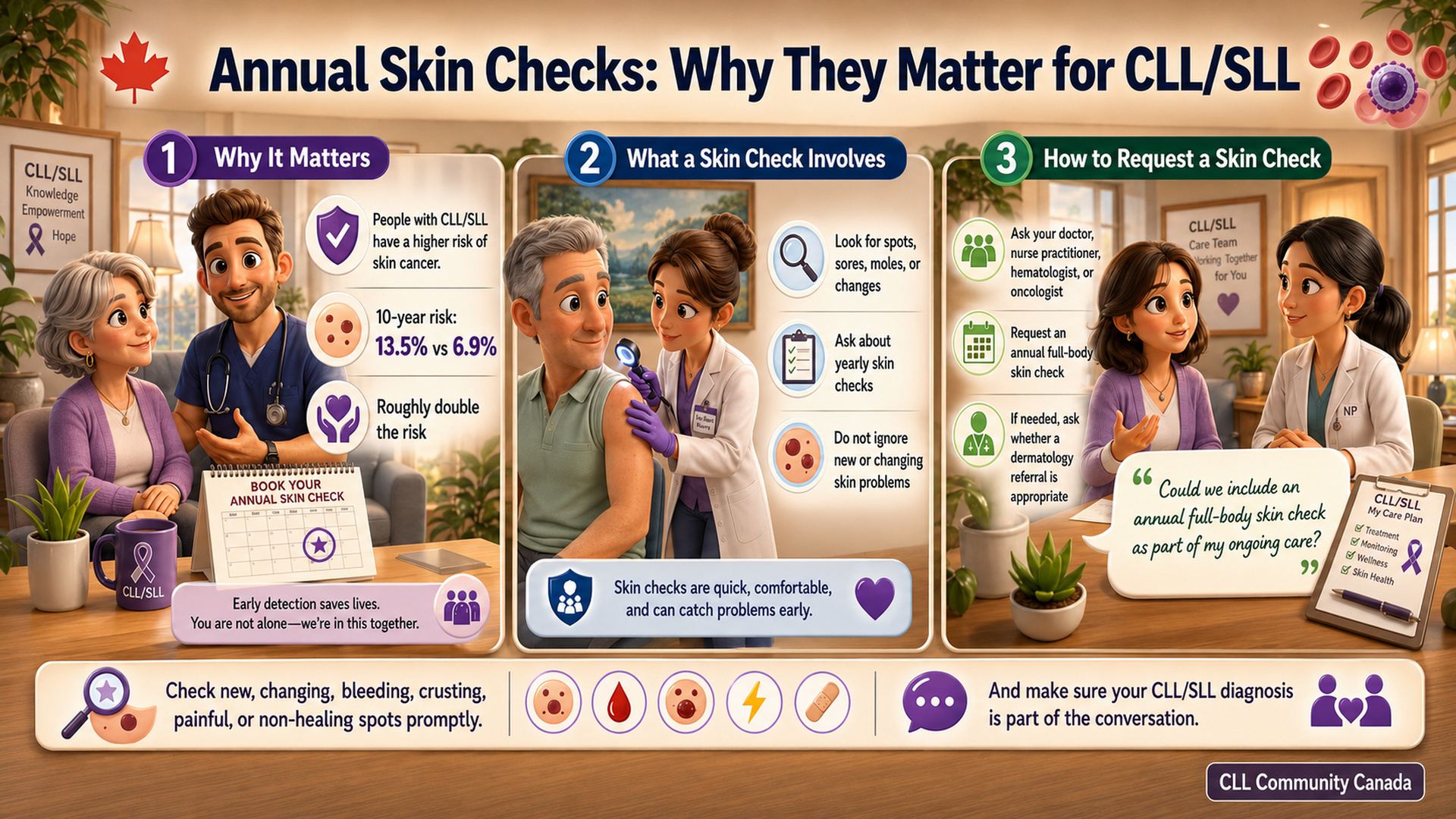
People with CLL/SLL face an increased risk of skin cancer. Annual skin checks and prompt assessment of new, changing, or non-healing spots can support earlier detection and treatment.
Why Skin Checks Matter for People With CLL/SLL
When you are living with CLL/SLL, most of the attention naturally goes to bloodwork, appointments, infections, fatigue, and treatment decisions. Those things matter. But your skin also deserves regular attention.
People with CLL/SLL have a higher risk of developing some second cancers, including skin cancers such as basal cell carcinoma and squamous cell carcinoma. One large 2026 cohort study reported that, over 10 years, people with CLL had a 13.5% risk of developing skin cancer, compared with 6.9% in people without CLL. In plain language, that is roughly double the risk.
That number is useful, but it is not a personal prediction. Each person’s actual risk can be affected by age, sun exposure, skin type, past skin cancers, immune status, and treatment history. The point is not to worry people. The point is to make sure skin changes are not brushed aside as “just one more thing.”
A yearly skin check is a sensible part of ongoing CLL/SLL care. It gives a health-care provider a chance to look for spots, sores, moles, or other changes that may need closer attention. Skin cancers are often more manageable when found early, so this is a practical step worth discussing.
What a Skin Exam Involves
A skin exam is usually straightforward. A doctor, nurse practitioner, dermatologist, or another qualified health-care provider checks your skin carefully, looking for spots, sores, moles, or other changes that may need follow-up. Depending on your situation, this may start with your family doctor or nurse practitioner, with a dermatology referral if something looks suspicious or needs a more specialized assessment.
It is especially important to ask about a skin exam if you have had skin cancer before, have significant sun damage, notice a sore that does not heal, or see a spot that is new, changing, bleeding, crusting, painful, or growing quickly.
Do not wait for your next CLL appointment if something looks concerning. A new or changing skin problem should be checked promptly.
How to Request a Skin Check
In Canada, the first step is usually to ask your family doctor, nurse practitioner, hematologist, oncologist, or another appropriate health-care provider for a skin check. Depending on your province, your provider may examine your skin themselves, refer you to a dermatologist, or suggest another local pathway. Access and wait times vary, so the process may not look the same everywhere.
A simple way to raise the issue is to say:
“I have CLL/SLL and understand that my risk of skin cancer may be higher. Could we include an annual full-body skin check as part of my ongoing care?”
If you have a specific spot that concerns you, be direct:
“I have a spot that is new, changing, bleeding, crusting, painful, or not healing. Can you please examine it and let me know whether I should be referred to a dermatologist?”
These questions are clear, respectful, and medically relevant. They also give your provider room to decide the best next step based on your history, your skin, and your local referral options.
If a skin check is not offered, ask what follow-up plan they recommend. You can also ask that your CLL/SLL diagnosis and increased skin-cancer risk be noted in your chart. That helps keep the issue visible during future visits.
A Practical Habit, Not a Reason to Panic
This is not meant to alarm anyone. It is a practical reminder that skin health deserves a place in ongoing CLL/SLL care.
A yearly skin check is a reasonable habit to discuss with your health-care provider, especially because people with CLL/SLL may have a higher risk of skin cancer. For some people, the check may be done by a family doctor or nurse practitioner. For others, a dermatology referral may be appropriate, particularly if there is a concerning spot, a past history of skin cancer, or other risk factors.
The main point is simple: do not ignore new, changing, bleeding, crusting, painful, or non-healing skin changes. Ask for them to be checked, ask what follow-up is recommended, and make sure your CLL/SLL diagnosis is part of the conversation.
Skin checks are not dramatic. They are not complicated. But they are one more sensible way to look after yourself while living with CLL/SLL.
Sources to Consider
Canadian Cancer Society — Skin exam
Alberta Health Services — Chronic Lymphocytic Leukemia guidance
Princess Margaret Cancer Centre / UHN — CLL clinical guidance
CLL Society — Skin cancer screening and CLL/SLL