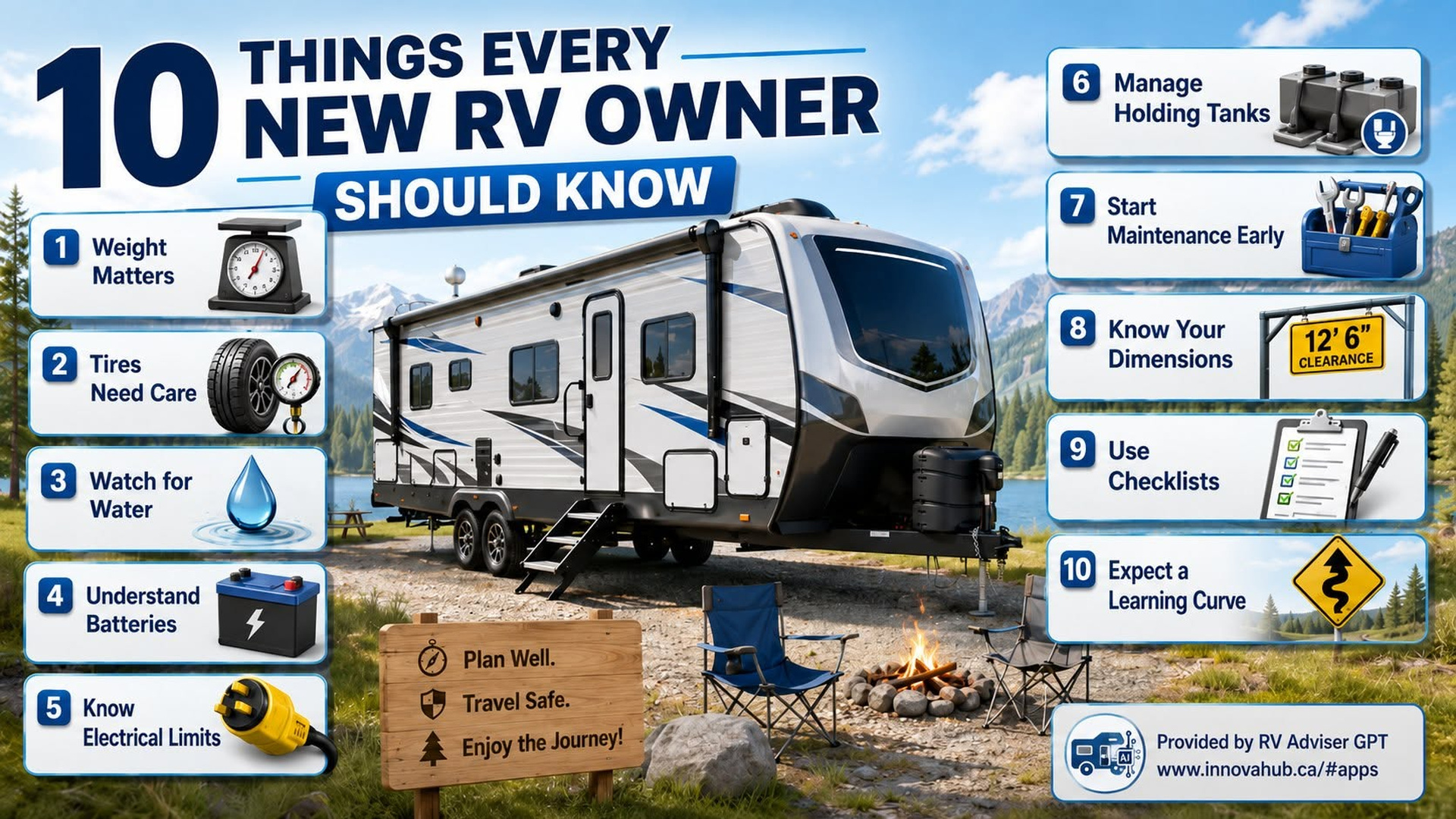
Buying your first RV is exciting, but there is a reality new owners quickly discover: an RV is not just a vehicle, and it is not quite a house. It is a vehicle, electrical system, plumbing system, battery bank, propane system, and small home all packed together and bounced down the highway.
Overview
That sounds intimidating, but most RV problems are not mysterious. Many are predictable and preventable once you understand a few basics. These are ten lessons I believe every new RV owner should learn early.
1. Weight Matters More Than You Think
Every RV has weight limits for the vehicle, axles, tires, and, where applicable, the hitch and towing system. Those numbers are not suggestions.
Water, passengers, food, tools, batteries, and camping gear add weight surprisingly quickly. Just as important, that weight may not be evenly distributed between the axles or individual tires. Load the RV as you normally travel and have it properly weighed. Actual numbers beat guesswork every time.
2. Tires Usually Fail for a Reason
When an RV tire fails, the tire or its origin often gets blamed immediately. Sometimes it really is a defective tire, but underinflation, overloading, age, impact damage, and poor maintenance are more common contributors.
Check pressures when the tires are cold, inspect them regularly, and understand the correct pressure requirements for your RV and actual tire loads. A tire can look perfectly good while a problem is developing underneath.
3. Water Is an RV's Expensive Enemy
A small roof, window, plumbing, or exterior seam leak can quietly damage walls, floors, insulation, and structural materials long before you see obvious evidence.
Inspect sealants, roof seams, windows, and exterior penetrations regularly. Inside, investigate stains, soft flooring, swelling, or musty smells immediately. Water damage rarely fixes itself. Funny how that works.
4. Batteries Are Widely Misunderstood
RV batteries do far more than run the lights. Depending on the RV, the 12-volt system may be involved in the furnace, refrigerator controls, water heater, water pump, slides, and other equipment.
Learn what type of batteries you have, how they are charged, and how deeply they can safely be discharged. The basic indicator panel found in many RVs is often a rough guide at best. Proper battery monitoring removes a lot of the guessing.
5. RV Electrical Systems Have Limits
A 30-amp or 50-amp connection does not provide unlimited power. Air conditioners, microwaves, electric water heaters, hair dryers, and coffee makers can draw significant amounts of electricity.
Learn the basic difference between 12-volt DC and 120-volt AC power and which systems use each. You do not need to become an electrician, but you should understand why running the air conditioner, microwave, and hair dryer at the same time might not end well.
6. Holding Tanks Require Proper Management
Black and grey tanks are fairly simple systems, but poor habits can create unpleasant problems.
Keep the black tank valve closed until the tank is ready to dump, and use plenty of water. Leaving the valve open while connected to sewer can allow liquids to drain while solids remain behind, creating the infamous "poop pyramid." Grey tanks also benefit from regular flushing and cleaning.
7. Maintenance Starts the Day You Buy the RV
A new RV is not a maintenance-free RV. Sealants, tires, batteries, appliances, slides, generators, brakes, and plumbing systems all require inspections or scheduled attention.
Start a simple maintenance record immediately. Waiting until something breaks is usually the most expensive maintenance plan available.
8. Know Your Height, Length, and Width
You should know your RV's actual dimensions without digging through a manual.
Low bridges, fuel station canopies, narrow roads, and tight campgrounds do not care that you are new. Know the travelling height, including rooftop equipment, and keep your important dimensions where the driver can easily see them.
9. Checklists Prevent Mistakes
Departure and arrival checklists are not just for beginners. Experienced RVers use them because experience teaches you how easily distractions lead to mistakes.
Awning in. Antenna down. Jacks raised. Steps retracted. Utilities disconnected. Storage compartments secured.
Memory is surprisingly unreliable when someone is talking to you, the dog is barking, and another camper is waiting for your site.
10. Every RV Has a Learning Curve
You will make mistakes. Every experienced RVer has.
The goal is not to know everything on day one. Learn your particular RV, read the manuals, ask questions, and try to understand why problems happen rather than simply blaming bad luck.
The best RV owners are not people who never encounter problems. They are the ones who keep learning and avoid making the same mistake twice.